

Are you struggling to set the right price for your lawn mowing services? You’re not alone. Many lawn care professionals face the challenge of balancing profitability with competitiveness in the market.
Pricing lawn mowing services for a 2-acre property requires careful consideration of various factors, including lawn size, condition, and regional market rates. Lawn mowing prices can range from $30 to $100 per visit, with hourly rates between $25 and $60.
To determine the optimal rate for your services, you need to understand the factors that influence pricing decisions and explore different pricing models. This comprehensive guide will walk you through the process, providing actionable insights to help you maximize profits while delivering excellent lawn care service.
Key Takeaways
- Understand the factors that influence lawn mowing pricing decisions.
- Explore different pricing models to determine the optimal rate for your services.
- Learn how to balance profitability with competitiveness in the market.
- Discover how to provide fair value to customers while maximizing profits.
- Get insights into national averages and specific pricing considerations for 2-acre properties.
Understanding the National Average for Lawn Mowing Prices
To determine fair pricing, it’s essential to understand the national average for lawn mowing services. The average cost of lawn mowing is influenced by several factors, including the size of the lawn, the frequency of mowing required, and the regional cost of living.
Basic Price Ranges Across the U.S.
Lawn mowing prices across the United States vary, but there are general price ranges that can be expected. On average, homeowners pay between $30 to $100 per mowing session, depending on the size of the lawn and the complexity of the job. For a 2-acre lawn, the average cost can range from $50 to $150 per visit.
The national average for lawn mowing services is influenced by labor costs, equipment expenses, and the cost of living in different areas.
Regional Price Variations
Regional variations in lawn mowing prices are significant due to differences in cost of living, labor costs, and climate conditions. Urban and coastal areas tend to have higher prices due to increased operating expenses.
- Urban areas like New York and San Francisco have higher rates, often 15-25% above the national average.
- Southern states have lower per-visit rates but require more frequent mowing, balancing out the monthly cost.
- The Midwest and rural areas generally have more competitive pricing, often 10-20% below the national average.
Understanding these regional variations is crucial for lawn care professionals to set competitive and fair prices in their area.
How Much to Charge for Mowing 2 Acres

Determining the right charge for mowing 2 acres involves considering several factors, including the size of the lawn, its condition, and the pricing model you choose. Lawn care professionals must balance their pricing to ensure it’s competitive while covering their costs.
Standard Price Range for 2-Acre Properties
For 2-acre properties, the standard price range can vary significantly based on factors like location, lawn condition, and the equipment used. Typically, hourly rates for mowing larger properties range from $35 to $75 per hour. Most 2-acre lawns require 2-4 hours to mow, resulting in total costs between $70 and $300.
When determining the price, consider the complexity of the job, including the terrain and any obstacles. This will help you decide between an hourly rate and a flat rate.
Hourly vs. Flat Rate for Larger Properties
Lawn care professionals often debate between hourly and flat-rate pricing models. Hourly pricing makes sense for jobs that are labor-intensive or when the time required is uncertain, such as a first-time mow on an overgrown property. On the other hand, flat-rate pricing provides clients with price certainty and rewards efficient operators.
A hybrid approach can also be effective, offering a base flat rate with additional hourly charges for complex conditions or extra services. This flexibility can help in managing client expectations and ensuring profitability.
Key Factors That Affect Your Pricing
When determining how much to charge for mowing 2 acres, several key factors come into play that can significantly impact your pricing strategy. These factors can be broadly categorized into lawn condition, terrain complexity, equipment and labor costs, and travel time along with service frequency.
Lawn Condition and Grass Type
The condition and type of grass on a 2-acre lawn significantly affect mowing time and difficulty. Lawns with thick, tall, or wet grass require more time and effort to mow than those with well-maintained, dry grass. Grass type is also a crucial factor; for instance, lawns with dense or coarse grass like buffalo grass or Bermuda grass may demand more powerful equipment and more time.
Terrain Complexity and Obstacles
The complexity of the terrain and the presence of obstacles such as trees, gardens, or slopes can greatly impact mowing time and pricing. Lawns with many obstacles require more maneuvering and potentially specialized equipment, increasing labor time. Terrain complexity also affects equipment wear and tear, influencing overall costs.
| Terrain Type | Mowing Time Impact | Pricing Impact |
|---|---|---|
| Flat, open lawn | Low | Lower costs |
| Lawn with obstacles | Moderate | Moderate costs |
| Hilly or complex terrain | High | Higher costs |
Equipment and Labor Costs
Equipment quality and labor costs are significant factors in determining pricing. High-quality equipment may be more expensive upfront but can reduce long-term costs through efficiency and durability. Labor costs, including the cost of skilled labor and insurance, also directly impact pricing. Ensuring that your pricing covers these costs is crucial for profitability.
Travel Time and Frequency of Service
Travel time to and from job locations, as well as the frequency of service, are critical in pricing calculations. Grouping jobs geographically can help minimize travel time and costs. For properties far from your base, consider adding a travel surcharge. Service frequency affects pricing strategy, with more frequent services potentially offering economies of scale.
By understanding and incorporating these factors into your pricing strategy, you can ensure a profitable and competitive lawn mowing business. Establishing service contracts with guaranteed frequency can help stabilize income and allow for more competitive pricing.
Different Pricing Models for Lawn Care Services
Selecting the appropriate pricing model is essential for lawn care service providers to ensure financial sustainability. Various pricing strategies can be employed, each with its own advantages and considerations.
Flat-Rate Pricing
Flat-rate pricing involves charging a fixed price for a specific service, regardless of the time taken. This model is beneficial for customers who prefer predictable costs and can be attractive for simple, routine services. For instance, a flat rate of $40 for mowing a standard-sized lawn provides clarity for both the customer and the service provider.
Hourly Pricing
Hourly pricing is based on the actual time spent on a job. This model is suitable for complex or variable tasks where the time required can’t be accurately predetermined. Lawn care businesses can charge an hourly rate, typically ranging from $30 to $75 per hour, depending on the expertise and location.
Per Square Foot or Per Acre Pricing
Pricing based on the area of the lawn is another common approach. This method is fair for customers with varying lawn sizes. For example, charging $0.01 per square foot or a fixed rate per acre provides a clear correlation between the service area and the cost.
Package or Subscription Pricing
Package or subscription pricing models bundle multiple services into one monthly or seasonal fee, often at a slight discount. This approach builds predictable income for businesses and creates “stickier” customers. For 2-acre properties, monthly subscription packages can range from $400 to $800, while seasonal contracts can range from $2,000 to $5,000.
- Package or subscription pricing models offer 10-15% savings compared to à la carte pricing.
- These models provide lawn care businesses with predictable recurring revenue.
- Popular package structures include tiered options (basic, premium, deluxe) or seasonal packages that adjust service frequency based on grass growth patterns.
By understanding and implementing these different pricing models, lawn care service providers can better meet customer needs while maintaining a profitable business.
Residential vs. Commercial Lawn Mowing Rates
Understanding the differences between residential and commercial lawn mowing rates is crucial for lawn care businesses. The pricing strategies for these two sectors vary significantly due to different client needs and service requirements.
Residential Pricing Strategies
Residential lawn mowing services typically involve smaller properties with more personalized service requirements. When determining residential pricing, we consider factors such as lawn size, grass type, and the presence of obstacles. Residential clients often prioritize service quality and reliability, allowing for more flexible pricing models. For instance, a flat rate per visit or hourly rate can be effective for residential services.
We also need to account for the competitive landscape and client expectations in residential areas. “The key to successful residential pricing is balancing competitiveness with the quality of service,” as noted by industry experts. By focusing on customer satisfaction and building strong relationships, we can establish a loyal client base.
Commercial Pricing Considerations
Commercial lawn care services, on the other hand, involve larger properties and more complex service needs. Commercial clients, such as office parks and HOAs, require professional-grade service, fast response times, and detailed documentation. When pricing commercial services, we consider factors like the size of the property, the scope of work, and contractual requirements.
- Commercial pricing for 2-acre properties typically ranges from $150-$350 per service.
- Insurance requirements are higher for commercial properties, often necessitating $1-2 million in liability coverage.
- Contracts for commercial properties include performance clauses and specific equipment requirements.
While commercial rates may be lower per acre than residential rates, the consistency and volume of commercial contracts can make them more profitable over time. As shown in the image below, commercial lawn care involves a broader range of services and more complex operations.
By understanding these differences, lawn care companies can develop effective pricing strategies for both residential and commercial clients, ensuring a sustainable and profitable business model.
Profitable Add-On Services for Lawn Care Businesses
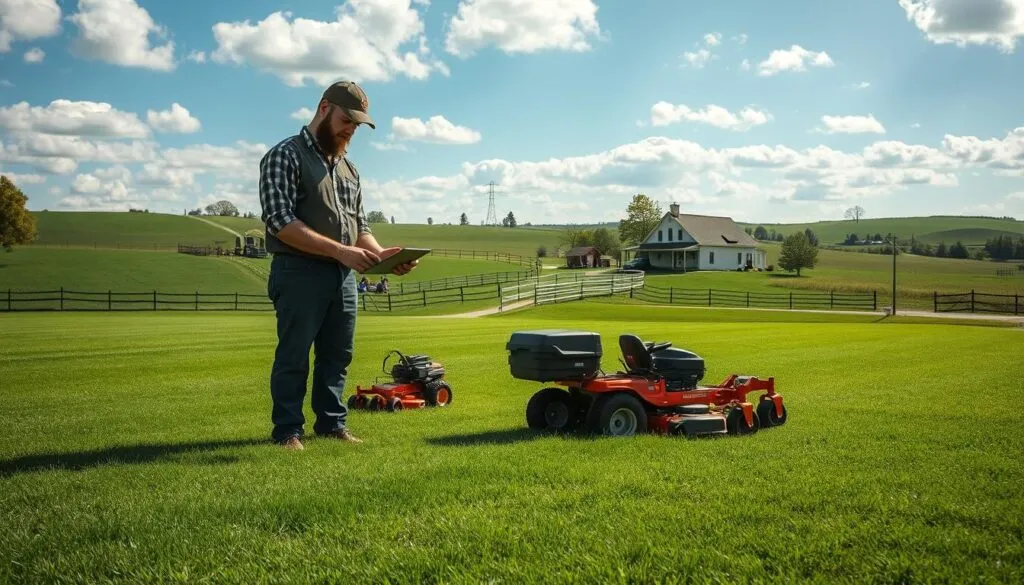
By diversifying your services, you can attract more clients and increase revenue for your lawn care business. Offering a range of add-on services not only enhances your value proposition but also allows you to capitalize on the existing client base.
Popular Add-On Services and Their Pricing
Lawn care businesses can significantly boost their revenue by incorporating popular add-on services into their offerings. Some of the most profitable add-ons include edging, blowing, fertilization, and seasonal cleanups. For instance, offering a Bronze, Silver, and Gold tiered service package can cater to different client needs while increasing average transaction values.
These packages can be structured as follows: Bronze might include weekly mowing and trimming, Silver adds edging and blowing, and Gold includes all the previous services plus fertilization and a fall cleanup. Pricing for these packages should reflect the complexity and cost of the services included.
How to Effectively Offer and Bundle Services
To effectively offer and bundle services, lawn care companies should consider creating seasonal bundles that combine core mowing services with timely add-ons. For example, spring cleanup, summer weed control, and fall aeration can be bundled with mowing services to provide comprehensive lawn care. Offering modest discounts on bundled services can encourage clients to commit to multiple services.
Additionally, developing maintenance agreements that automatically include seasonal services can simplify client decision-making and ensure a steady revenue stream throughout the year. Introducing add-on services through limited-time promotions or first-time client specials is also an effective strategy to demonstrate value and convert single-service clients into comprehensive lawn care customers.
Pricing Psychology: How to Compete Without Undercutting Yourself

Effective pricing strategies are the backbone of a thriving lawn care business, enabling professionals to compete without undercutting their services. As lawn care professionals, we understand that pricing is not just about covering costs; it’s about reflecting the value we bring to our clients.
The Trap of Competing on Price Alone
Competing solely on price can lead to a race to the bottom, where profit margins are squeezed, and the quality of service suffers. Successful lawn care professionals know that their pricing should reflect the total value delivered, including reliability, quality, convenience, and professionalism. For instance, using professional equipment and systematic approaches can justify premium pricing 20-30% above market averages for 2-acre properties.
Pricing for Value and Knowing When to Walk Away
Pricing for value means understanding that not every prospect is worth converting. We need to identify problematic clients early, characterized by pushback on every quote, disrespect for our time, or unrealistic expectations with low budgets. Establishing clear service boundaries and minimum pricing thresholds protects our business from unprofitable work and attracts ideal clients who value quality and are willing to pay fair rates.
By developing the confidence to walk away from price-focused prospects, we ensure long-term business sustainability. These clients typically require more time and attention while generating lower profits. Our pricing should reflect the quality of our work, our reliability and professionalism, and the overall experience we offer to clients.
Creating a Professional Lawn Care Pricing Structure
To stand out in the competitive lawn care market, businesses must develop a pricing structure that reflects the value they provide. A well-organized pricing structure helps lawn care professionals to accurately quote services and maintain business sustainability.
Sample Pricing Templates for Different Lawn Sizes
Using a basic spreadsheet template or pricing tool can significantly speed up the quoting process. These tools should factor in square footage, service type, frequency, add-ons, travel time, and margin goals. For instance, a template for a 2-acre lawn might include different pricing tiers based on the complexity of the terrain and the services required.
- Square footage: Determine the exact size of the lawn.
- Service type: Differentiate between basic mowing, edging, and additional services like fertilization or pest control.
- Frequency: Account for how often the service is needed, whether weekly, bi-weekly, or monthly.
Building Quotes and Estimates for 2-Acre Properties
Professional quotes for 2-acre properties should include detailed breakdowns of services, clearly separating base mowing costs from add-on services. Using satellite imagery or property measurement tools like Google Earth can help create accurate estimates without time-consuming on-site measurements.
Effective quotes should also account for the specific challenges of the individual property, including terrain complexity, obstacles, access points, and any special requirements. Including visual elements such as property maps with service zones clearly marked can help clients understand the scope of work and justify pricing.
Key elements to include in your quote:
- Detailed breakdown of base mowing costs.
- List of add-on services with their respective costs.
- Visual aids like property maps to illustrate the scope of work.
Common Pricing Mistakes to Avoid
Accurate pricing is essential for lawn care businesses to maintain profitability. Lawn mowing services require careful consideration of various factors to ensure that prices are competitive yet profitable.
Underestimating Costs and Overhead
Underestimating costs can lead to reduced profitability. Lawn care businesses must consider equipment maintenance, fuel, labor, and other overhead costs when setting prices. For instance, the cost of maintaining a lawn mower can be substantial, and failing to account for this can erode profit margins.
Failing to Account for Seasonal Variations
The season will determine how often you mow. Cool-season grasses like Kentucky bluegrass need weekly mowing during spring and fall, while warm-season grasses like Bermuda grass require it during summer. Failing to adjust pricing for these seasonal demands can lead to rushed service and reduced profitability during peak seasons.
Effective pricing strategies for 2-acre properties include seasonal adjustments that reflect the changing demands throughout the year. Creating annual service contracts that distribute payments evenly throughout the year helps manage cash flow while ensuring clients receive appropriate service frequency based on seasonal growth patterns.
Conclusion: Building a Sustainable Lawn Care Business
As lawn care professionals, we understand that pricing is not just about covering costs but about creating a sustainable business model that benefits both our clients and our companies. Determining the right price for mowing 2-acre properties requires balancing multiple factors, including regional market rates, property-specific challenges, and business overhead costs. Successful lawn care businesses develop comprehensive pricing strategies that account for all expenses while providing fair value to clients, typically charging between $175-$375 for standard 2-acre mowing services.
Implementing professional pricing structures with clear service definitions and appropriate add-on options helps establish your business as a serious industry competitor. Building long-term client relationships through consistent quality, reliable service, and transparent pricing creates a sustainable business model. Regularly reviewing and adjusting your pricing strategy ensures continued profitability while allowing for equipment upgrades and service improvements.
By focusing on quality service, fair employee compensation, and reasonable profits, lawn care professionals can build a thriving business that stands the test of time. Effective lawn care services require a deep understanding of lawn mowing costs and pricing models.
FAQ
What is the average cost of lawn mowing per hour?
The average cost of lawn mowing per hour varies depending on location, equipment, and labor costs, but typically ranges from to per hour.
How do I determine the price for mowing a 2-acre lawn?
To determine the price, consider factors such as lawn condition, terrain complexity, equipment costs, and labor time. We can use a flat rate, hourly rate, or per square foot pricing model.
What is the standard price range for mowing a 2-acre property?
The standard price range for mowing a 2-acre property can vary, but typically falls between to 0 per visit, depending on the services offered and local market rates.
Should I use a flat rate or hourly rate for lawn mowing services?
Both flat rate and hourly rate pricing models have their advantages. Flat rate pricing provides a clear estimate for customers, while hourly rate pricing accounts for variations in lawn complexity and labor time.
How do regional price variations affect lawn mowing costs?
Regional price variations can significantly impact lawn mowing costs, as labor costs, equipment expenses, and market rates differ across the U.S. We must research local market conditions to set competitive prices.
What are some profitable add-on services for lawn care businesses?
Profitable add-on services include fertilization, pruning, aeration, and landscaping. These services can increase average revenue per customer and enhance our overall service offerings.
How can I effectively offer and bundle services to customers?
To effectively offer and bundle services, we should assess customer needs, provide customized solutions, and clearly communicate the value of our services. This approach can increase customer satisfaction and loyalty.
What are common pricing mistakes to avoid in lawn care businesses?
Common pricing mistakes include underestimating costs and overhead, failing to account for seasonal variations, and competing solely on price. We must carefully consider these factors to establish a sustainable pricing structure.