
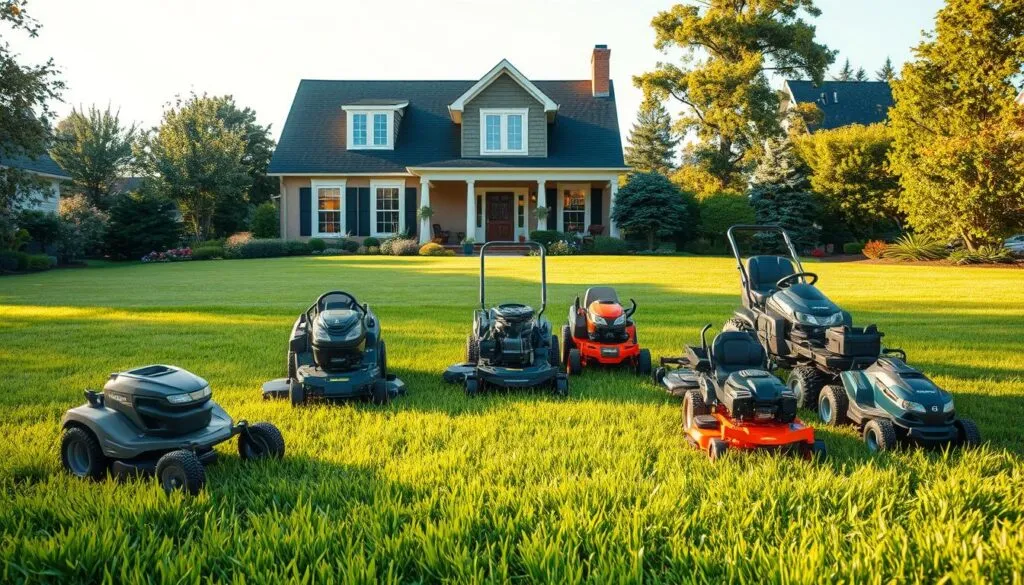
That beautiful, expansive green space you love can quickly feel like a chore if you’re using the wrong tools. I’ve learned that maintaining a large property efficiently hinges on one critical choice.
While the average lawn is much smaller, a full acre demands serious consideration. Your decision impacts everything from your weekend schedule to your physical energy.
You could spend hours pushing a machine that’s not up to the task. Or, you might invest in a powerful rider that zips through the job in half an hour. The gap between frustration and efficiency is that wide.
This guide cuts through the confusion. I’ll help you match your unique situation—your budget, your available time, and your property’s features—to the perfect machine. Let’s find the equipment that turns your lawn care back into a pleasure.
Key Takeaways
- A one-acre property is significantly larger than the average lawn and requires more powerful equipment.
- The right choice saves you considerable time, with mowing durations ranging from 30 minutes to over three hours.
- Key factors include your budget, physical capability, and the specific characteristics of your yard.
- Selecting incorrectly can lead to frustration, exhaustion, and unnecessary expense.
- This guide provides a personalized approach to identify the best deck size, power source, and type for your needs.
Understanding My 1-Acre Lawn and Mowing Needs
Matching a mower to your land is a personal process. It begins with an honest look at your terrain, available time, and tolerance for physical work.
Assessing Lawn Terrain and Obstacles
Your property’s layout is the first critical factor. Is the ground mostly flat, or does it have gentle or steep hills? Standard riding mowers can struggle on slopes over 15 degrees.
For hilly lawns, robotic or remote-control options are impressive. They can handle inclines where traditional machines might be unsafe.
Next, count the obstacles. Trees, gardens, and other features demand a nimble machine. An open yard allows for a wider cutting deck, which speeds up the job significantly.
Also, identify any problem spots. Wet areas or rocky patches can damage certain types of equipment. Knowing your yard‘s challenges prevents costly mistakes.
Budget, Time, and Physical Considerations
Your personal needs are just as important as the land itself. How long do you want to spend mowing? If your limit is 30-45 minutes, a walk-behind model for a one-acre property isn’t practical.
Budget is another key element. Prices range from a few hundred dollars for basic models to several thousand for advanced riders or robotic systems.
Finally, consider your own stamina. Pushing a machine across a large lawn requires energy. A riding mower reduces physical strain but needs storage space. This self-assessment ensures you invest in equipment you’ll truly use and enjoy for years.
Factors to Consider When Choosing What Size Mower for 1 Acre
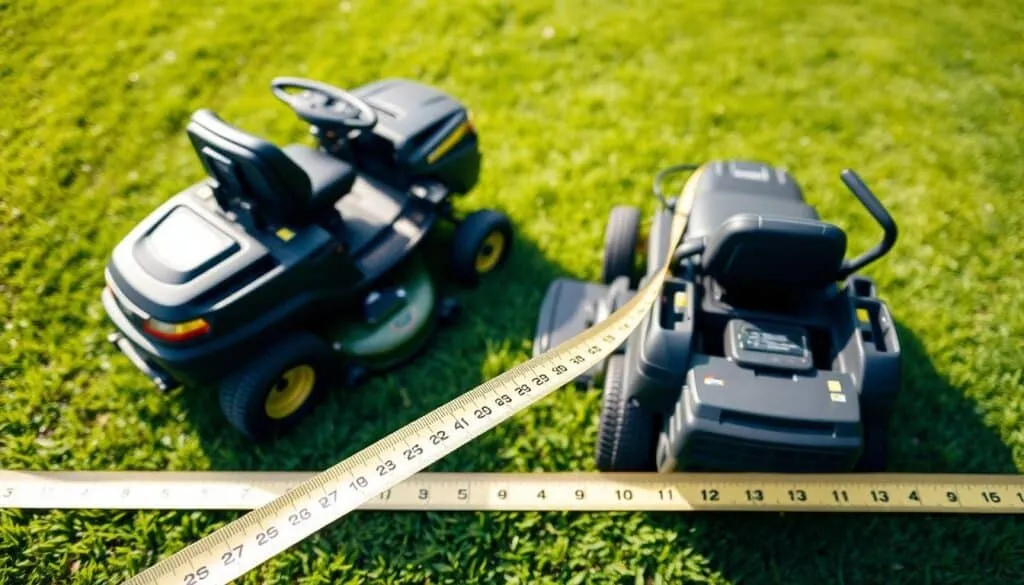
Proper equipment selection requires analyzing both physical specifications and personal comfort factors. The right combination ensures efficient maintenance without unnecessary strain.
Deck Size, Cutting Width, and Engine Power
Cutting width dramatically impacts your mowing time. A wider deck covers more ground with each pass, reducing total work duration significantly.
| Mower Type | Deck Size Range | Estimated Time for 1 Acre | Engine Power |
|---|---|---|---|
| Push Mower | 20-22 inches | 2+ hours | N/A |
| Self-Propelled | 28-42 inches | 1.5-2.5 hours | 12-20 hp |
| Standard Riding | 38-54 inches | 35-45 minutes | 14-20+ hp |
| Zero-Turn | 42-54 inches | 20-25 minutes | 18-25+ hp |
Engine strength matters for consistent performance. More horsepower maintains blade speed in challenging conditions like thick or wet grass.
Push Mowers Versus Riding Mowers: Which Suits Me Best?
Walk-behind models demand physical stamina and considerable time commitment. They work for those who enjoy exercise and have flexible schedules.
Riding equipment offers comfort and speed. This type suits people with limited time or physical constraints. Consider storage space and terrain compatibility when choosing between these options.
Comparing Different Types of Lawn Mowers
The market offers a wide array of cutting solutions, each with distinct advantages for different property layouts. Understanding these categories helps you match equipment to your specific maintenance needs.
Walk-Behind, Self-Propelled, and Agricultural Options
Walk-behind models represent the most budget-friendly choice. Basic push versions demand significant physical effort across large spaces.
Self-propelled options reduce operator fatigue with powered wheels. They offer a middle ground for homeowners seeking affordability without exhaustive workouts.
Front-wheel drive models excel on flat terrain with obstacles. Rear-wheel drive provides superior traction for sloped areas.
Riding, Robotic, and Remote Control Mowers Explained
Riding equipment delivers comfort and efficiency for expansive properties. These machines complete the job quickly with minimal physical strain.
Robotic systems operate autonomously using smart navigation. They work gradually but handle complex terrain effectively.
Remote control units combine precision with operator convenience. You guide the cutting from a distance, avoiding weather exposure.
Gas-powered engines maintain consistent performance in challenging conditions. Electric alternatives offer quieter operation with reduced maintenance needs.
Expert Tips for a Perfect Mowing Experience
Even the best machine underperforms without proper care and smart operational practices. I’ve learned that consistent maintenance and safety awareness transform your routine.
Optimal Maintenance and Safety Practices
Regular upkeep keeps your equipment running smoothly. I change oil frequently and sharpen blades every 20-25 hours.
Safety should never be compromised. I always wear closed-toe shoes and eye protection. Hearing protection is crucial with loud engines.
Modern features reduce maintenance headaches. Electric starting systems eliminate frustrating pull cords. The ReadyStart™ technology needs no priming.
Battery care extends electric mower life. Avoid complete discharges and store batteries properly. Capacity decreases about 6% yearly.
Maximizing Efficiency and Mower Performance
Smart patterns cut your time spent mowing. Alternate directions each session to prevent grass leaning.
Proper cutting height promotes lawn health. Taller grass suppresses weeds and needs less frequent attention. Match height to grass type and season.
Time your sessions for optimal results. Dry grass cuts cleaner than wet vegetation. Morning or evening avoids peak heat.
Handle challenging terrain with care. Reduce speed on slopes and avoid sharp turns. Adjust deck height for uneven ground.
Choose features matching your specific needs. Mulching systems fertilize naturally. Bagging keeps appearances pristine. Noise-reduction mufflers benefit close neighborhoods.
Conclusion
Your final decision on equipment selection will shape your weekend experience for years to come. The perfect choice depends entirely on your specific yard characteristics, personal preferences, and available time.
For most one-acre properties, riding mowers with 42-inch decks offer the best balance. They complete the job in about 30-35 minutes while providing excellent comfort. Basic push mower options demand 2-3 hours of strenuous work.
Challenging terrain with slopes or numerous obstacles may require specialized equipment. Consider compact riding models or advanced options like the Mowrator S1 for steep yards.
Always evaluate deck size, engine power, and cutting width together. Test different models when possible and read reviews specific to your yard size. This investment saves countless hours and ensures your lawn always looks its best.
FAQ
Is a riding lawn tractor necessary for my one-acre property?
While not an absolute necessity, a riding lawn tractor or a zero-turn mower is highly recommended for an acre of grass. Using a push mower or a small walk-behind model would require a significant amount of time and physical effort. A riding mower with a deck size between 42 and 54 inches offers the best balance of efficiency and maneuverability for this yard size.
What is the ideal cutting width for a mower deck on one acre?
I find that a cutting width between 42 and 54 inches is ideal for a one-acre lot. A 42-inch deck is a popular and effective choice, covering a good amount of ground without being too bulky to navigate around obstacles like trees and garden beds. A wider 54-inch deck will further reduce your total mowing time if your terrain is relatively open.
Can I use a gas-powered push mower for an acre?
Technically, you can, but I would strongly advise against it for most people. Mowing an entire acre with a push mower is extremely time-consuming and physically demanding. This type of mower is better suited for smaller lawns. For an acre, you’ll want to consider self-propelled walk-behind mowers or, more realistically, riding mowers to save time and energy.
How does the terrain of my yard affect my mower choice?
The terrain is a critical factor. If your acre has many hills, slopes, or uneven ground, you need a mower with sufficient engine power and a sturdy transmission. For gentle, flat lawns, a standard lawn tractor works well. For more complex terrain with numerous obstacles, a zero-turn mower offers superior maneuverability, though it may be less stable on steep hills than a tractor.
What are the main advantages of a zero-turn mower for a property this size?
The primary advantage of a zero-turn mower is its incredible efficiency. Its ability to turn sharply around obstacles reduces mowing time significantly compared to a traditional lawn tractor. This makes it an excellent choice for a one-acre yard, especially if you have many trees or flower beds to navigate around. They are designed for speed and precision.
Besides the mower itself, what other factors should I consider?
When choosing the right equipment, also think about storage space for the machine, your budget for both the initial purchase and long-term maintenance, and the availability of parts and service. Your personal comfort with operating different types of mowers and the time you are willing to spend mowing each week are also key considerations in your decision.