
Have you ever considered that the single most important fluid for your machine’s health might be the one you think about the least? Getting the lubrication right is not just a suggestion; it’s the lifeblood of your equipment’s engine.
Using an incorrect amount can lead to serious issues. Too little oil causes excessive friction and heat. Too much creates pressure that can damage seals. Knowing the precise volume your model requires is critical for peak performance.
This guide provides clear, specific information for various models. We cover walk-behind units, self-propelled mowers, and larger zero-turn riders. You will find the exact specifications to eliminate any guesswork.
Proper maintenance ensures your machine runs smoothly for years. We will also explore oil types and change intervals. Protect your investment and keep your lawn looking great.
Key Takeaways
- Correct oil volume is essential for engine health and longevity.
- Different Toro models have specific capacity requirements.
- Using too much or too little oil can cause significant engine damage.
- Manufacturer-recommended oil types vary based on climate and model.
- Regular oil checks and changes are part of essential maintenance.
- Knowing your mower’s exact capacity prevents costly repairs.
Introduction and Overview
Engine lubrication might seem like a basic task, but its importance cannot be overstated. Your machine’s reliability and lifespan depend on this fundamental maintenance practice.
Why Proper Oil Maintenance Matters
Correct fluid levels directly impact your equipment’s performance and durability. When you maintain the right amount, you ensure smooth operation throughout the mowing season.
Insufficient lubrication leads to excessive friction and overheating. Overfilling creates dangerous pressure that can damage critical components. Both scenarios risk expensive repairs.
Understanding the Role of Oil in Engine Performance
Engine oil circulates through internal components, reducing friction between moving parts. It also carries away heat and cleans vital surfaces.
This protective barrier prevents metal-on-metal contact that causes premature wear. Proper maintenance ensures optimal fuel efficiency and extends your machine’s service life.
Accurate information about your specific model’s requirements is essential. Different engines have unique specifications that affect performance and warranty coverage.
Understanding Your Toro Lawn Mower’s Engine Oil Requirements
Navigating the specific lubrication needs of your equipment requires understanding two critical factors: volume and viscosity. These specifications vary significantly across different equipment models and operating conditions.
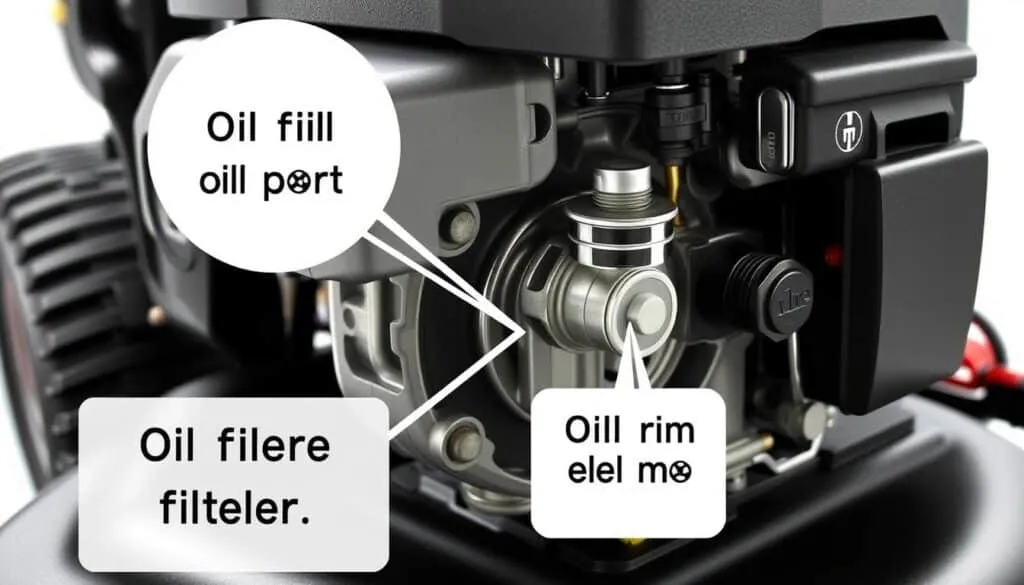
Engine Oil Capacity and Viscosity Guidelines
Your equipment’s engine oil capacity depends on the specific model you own. Walk-behind units typically need 15-18 ounces, while riding models require 48-64 ounces for proper lubrication.
Viscosity refers to the oil’s thickness and flow characteristics. The right grade ensures proper engine protection across different temperature ranges. SAE 30 works best in warmer climates above 40°F.
For varying temperature conditions, SAE 10W-30 provides better cold-weather starting. Synthetic options like SAE 5W-30 offer superior protection across all temperature ranges.
Manufacturer Recommendations and User Manuals
Always consult your owner’s manual for precise specifications. This document contains the exact oil capacity and viscosity requirements for your particular model.
The manual also specifies the API service classification needed, typically SJ or higher. Using high-quality detergent oil that meets these standards protects your engine from excessive wear.
If you’ve misplaced your manual, contact an authorized dealer for specific information. They can recommend the best oil type for your climate and mowing conditions.
how much oil does a toro lawn mower take?
The exact amount of lubricant your Toro equipment needs is not a one-size-fits-all answer. It varies significantly based on your specific machine’s design and power.
Knowing the precise volume is the first step to proper engine care. This information protects your investment and ensures reliable performance.
Model-Specific Oil Capacity Insights
Standard walk-behind models are quite straightforward. They typically require either 15 or 18 ounces of fluid, with many using exactly 18 ounces (0.5 liters).
Riding mowers have a much larger oil capacity. Their engines need either 48 or 64 ounces to operate correctly, depending on their size.
High-performance models like the Toro TimeCutter with a 24.5 HP engine are more complex. When you change the filter, the capacity is about 2.0 quarts (1.9 liters). Without a filter change, it’s approximately 1.7 quarts (1.6 liters).
Commercial zero-turn mowers with engines like the Kohler Confidant ZT740 or Kawasaki FR730V have similar requirements. They need between 1.7 and 2.1 quarts.
You must always verify your specific model’s requirements. Check the owner’s manual or the engine label for the exact oil capacity. This simple step prevents serious damage.
Step-by-Step Guide to Changing Your Toro Mower’s Oil
A systematic approach to engine care ensures optimal performance and prevents costly repairs. Following the correct procedure protects your investment throughout the mowing season.
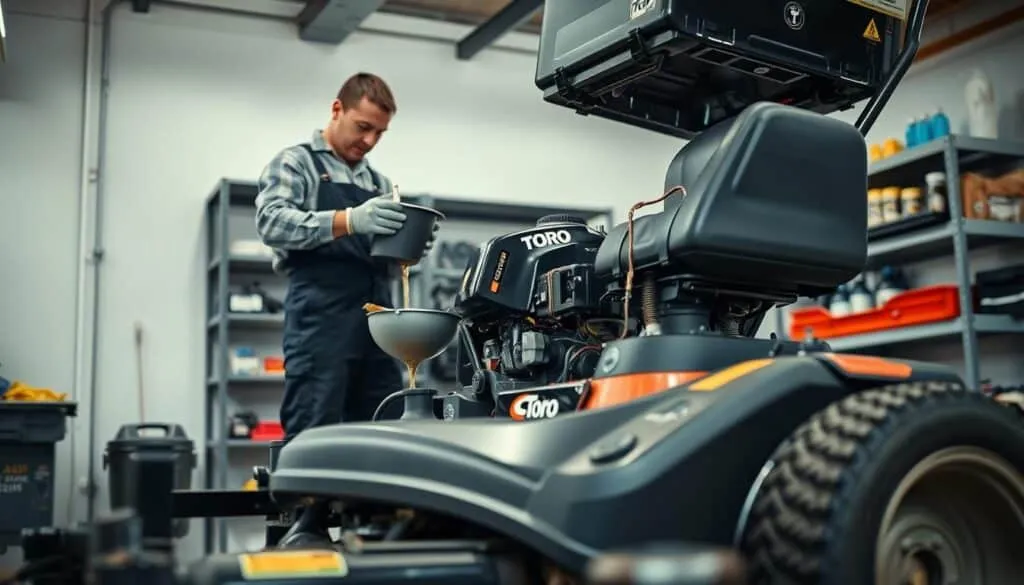
Preparing Your Mower for Maintenance
Begin by running the engine for a few minutes. Warm fluid flows better and carries more contaminants. This results in a more thorough drain.
Shut off the engine and disconnect the spark plug wire for safety. Wait for all moving parts to stop completely. Position your equipment on a level surface.
Empty the fuel tank through normal usage before tipping. If you must tip with fuel present, use a hand pump to remove it. This prevents spills during the process.
Detailed Oil Drain and Refill Procedures
Remove the dipstick by rotating the cap counterclockwise. Pull it out to access the fluid system. Tip the machine onto its side with the air filter up.
Allow the used fluid to drain completely from the fill tube. Return the equipment to the operating position. Carefully pour about three-quarters of the engine capacity.
Wait approximately three minutes for the fluid to settle. Check the level using the dipstick method. Adjust as needed to reach the proper mark.
Post-Change Checks and Safety Tips
Verify the fluid level falls between the “Add” and “Full” indicators. Use the dipstick multiple times for accuracy. Wipe it clean between each check.
Running the engine with incorrect levels causes damage. Too little causes inadequate lubrication. Too much increases pressure on engine parts.
| Maintenance Step | Key Action | Safety Consideration |
|---|---|---|
| Preparation | Disconnect spark plug | Prevents accidental starting |
| Draining | Tip with air filter up | Protects carburetor from fluid |
| Refilling | Add 3/4 capacity first | Avoids overfilling initially |
| Verification | Check dipstick multiple times | Ensures precise fluid level |
Reconnect the spark plug wire after completing all maintenance. Check for leaks before restarting the engine. Properly dispose of used fluid at a recycling center.
Choosing the Right Oil for Optimal Performance
Selecting the correct lubricant for your equipment is a critical decision that directly influences its power and longevity. The right engine oil type ensures smooth operation and maximum protection.
Your local climate and typical mowing patterns determine the ideal viscosity grade. This choice affects starting ease and overall engine health.
Comparing SAE 30, SAE 10W-30, and Synthetic Options
SAE 30 is the most common oil for warm climates. It provides excellent protection when temperatures stay above 40°F, making it ideal for the summer lawn care season.
For areas with varying temperature ranges, consider SAE 10W-30. This multi-grade type improves cold-weather starting. You may notice increased consumption in heat above 80°F.
Synthetic engine oil like SAE 5W-30 offers superior performance across all conditions. It provides easier cold starts, reduced consumption, and enhanced engine protection.
How Climate Affects Your Oil Choice
Temperature dramatically changes how lubricants flow. Thick oils like SAE 30 can cause hard starting below 40°F.
In very cold regions, SAE 5W-30 is the best type for reliable use. For heavy-duty commercial use in hot environments, a heavier grade like SAE 20W-50 may be specified.
Always check your owner’s manual for the required service classification (e.g., SJ or higher). Using high-quality detergent oil ensures proper engine performance and maintains your warranty.
Maintenance Tips and Service Intervals for Toro Mowers
Your Toro mower’s long-term performance hinges on adhering to a structured service schedule based on hours of operation. Following these maintenance tips ensures your equipment remains reliable throughout the mowing season.
Scheduled Maintenance and Additional Service Procedures
Begin with a critical first step. After the initial five hours of use, change the engine oil. This removes break-in contaminants.
Before each use, perform quick checks. Verify the oil level with the dipstick. Ensure the blade control stops the engine within three seconds.
Service intervals vary by model and use. Walk-behind mowers need an oil change every 50 hours or yearly. Riding mowers require this service every 100 hours.
Annual maintenance is essential. Service the air filter and sharpen the blade. Clean the cooling system, especially in dusty conditions.
Prepare for storage at the season’s end. Empty the fuel tank and change the oil. Follow your owner’s manual instructions closely.
| Service Interval | Key Action | Important Note |
|---|---|---|
| First 5 Hours | Change Engine Oil | Critical for new engine break-in |
| Before Each Use | Check Oil Level & Safety | Prevents engine damage and accidents |
| Every 25 Hours | Charge Battery (Electric-Start) | Maintains reliable starting power |
| 50/100 Hours or Yearly | Change Engine Oil | Whichever comes first based on model |
| Yearly / Before Storage | Comprehensive Service | Includes filter, blade, and fuel system |
For harsh conditions, increase service frequency. Your authorized dealer offers genuine replacement parts and expert advice.
Conclusion
The longevity of your outdoor power equipment depends heavily on consistent, proper lubrication practices. You now possess the essential knowledge to maintain optimal engine health throughout every mowing season.
Always verify the fluid level using your dipstick before each use. Follow manufacturer instructions for your specific model’s capacity and change intervals. This prevents damage and ensures peak performance.
Safety remains critical during all maintenance procedures. Disconnect the spark plug wire and work on level surfaces. Consult your owner’s manual for detailed guidance.
Proper care protects your investment for years of reliable service. Your authorized dealer can provide additional support and genuine replacement parts when needed.
FAQ
What is the typical engine oil capacity for a Toro walk-behind mower?
Most Toro walk-behind models with Briggs & Stratton or Toro engines hold approximately 20 ounces (0.6 quarts) of lubricant. Always verify this in your owner’s manual, as capacities can vary slightly between specific models and engine types.
How often should I change the lubricant in my Toro equipment?
You should perform an oil change after the first five hours of operation on a new machine. After that, service the engine every 50 hours of mowing or at least once per season for optimal protection and performance.
What type of oil should I use in my Toro lawn mower?
For most conditions, a high-quality detergent oil classified as API service SG, SH, SJ, or higher is recommended. Common viscosity grades include SAE 30 for consistent warm temperatures or SAE 10W-30 for regions with varying temperatures. Check your manual for the exact specification.
Where can I find the precise oil capacity for my specific Toro model?
The most accurate information is in your equipment’s owner’s manual. You can also find this data on the manufacturer’s official website by searching with your model number, which is typically located on a decal on the engine or mower deck.
What are the signs that my mower’s oil needs changing?
Key indicators include the lubricant appearing very dark and dirty on the dipstick, a low oil level, or the engine running roughly. Regular service based on operating hours is the best practice to avoid performance issues.