
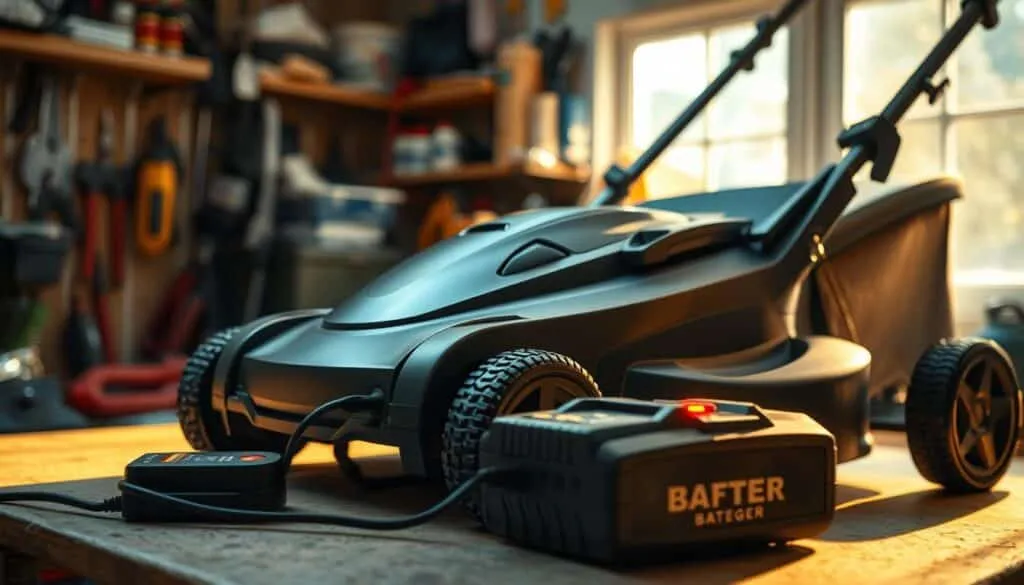
Have you ever considered that the simple act of starting your yard equipment is powered by a hidden electrical heart? This essential component provides the crucial spark to get your machine running smoothly.
Most riding equipment and lawn tractors depend on a robust lead-acid unit. Understanding its specific needs is key to ensuring your gear performs reliably all season long. You need to match the correct power source to keep everything functioning properly.
This vital part typically operates on a 12-volt system, though some smaller models use 6 volts. This detail directly influences your choice of equipment for replenishing its energy. You have several effective options available.
From dedicated maintenance devices to jump-starting from a vehicle, you can find a solution that fits your situation. Modern innovations even include portable power stations and smart units with automatic features. Proper care can dramatically extend the functional life of this critical piece of your outdoor power equipment.
Key Takeaways
- Your equipment’s electrical system relies on a healthy power cell to start the engine and operate components.
- Most modern units use a 12-volt system, which dictates the type of replenishment tool you need.
- Multiple methods exist for restoring power, including dedicated devices and portable stations.
- Correct maintenance practices can significantly increase the lifespan of your power source.
- Protecting the unit from extreme temperatures is crucial for long-term performance.
- Modern solutions offer convenience with features like automatic shutoff for safety.
- Replenishing energy before seasonal use and storage is essential for reliability.
Understanding Lawn Mower Batteries and Their Importance
When selecting energy storage for your outdoor cutting equipment, you face a fundamental choice between traditional and modern technologies. This decision impacts performance, maintenance requirements, and long-term costs for your yard maintenance tool.
Battery Types: Lead-Acid vs. Lithium (LiFePO4)
Traditional lead-acid batteries remain popular due to their affordability. These units typically last three to four years but require regular upkeep and add significant weight to your equipment.
Modern lithium-ion options, particularly LiFePO4 types, offer superior performance despite higher initial costs. They provide maintenance-free operation and can exceed ten years of service life. Their lightweight design makes handling your cutting tool much easier.
The Role of Regular Maintenance in Battery Performance
Proper care significantly extends the functional lifespan of your power source. Regular inspection and cleaning of terminals prevents corrosion that can disrupt electrical connections.
Storage practices also play a crucial role. Keep your energy unit in a cool, dry location away from extreme temperatures. Using trickle charging during off-season periods maintains optimal charge levels and prevents capacity loss over time.
Safety Precautions When Charging Your Lawn Mower Battery
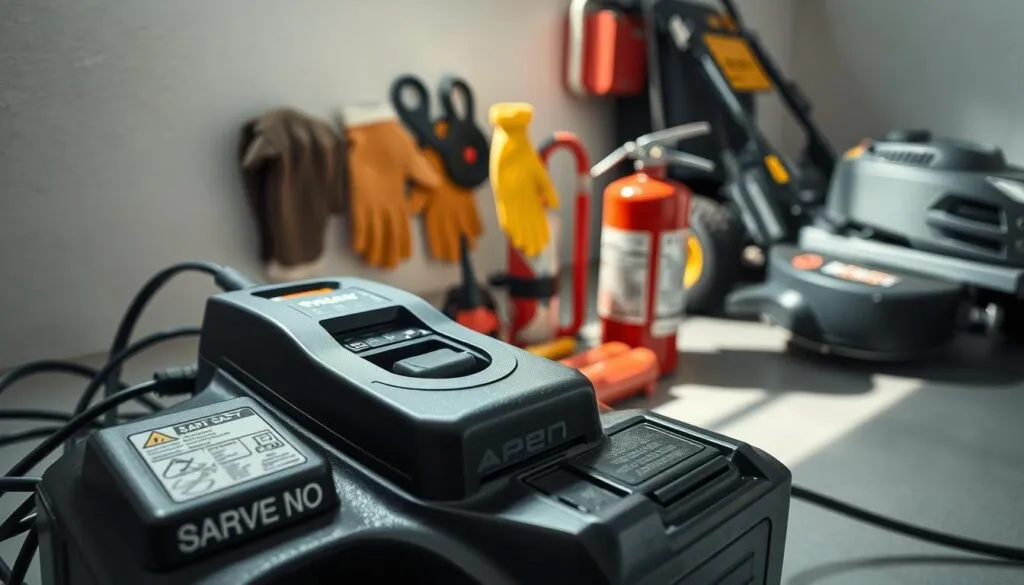
Taking the right precautions ensures a secure environment when restoring power to your cutting equipment. Proper preparation prevents accidents and protects both you and your machinery.
Protective Gear and Ventilation
Always wear safety glasses and gloves before handling electrical components. These items shield you from potential sparks or chemical exposure.
Choose a well-ventilated area for your work. Open spaces prevent dangerous fume accumulation. Keep flammable materials far from your charging station.
Remove metal jewelry and tools from your workspace. Accidental contact with terminals can cause hazardous short circuits.
Handling, Storage, and Inspection Tips
Inspect your power unit carefully before beginning. Look for cracks, bulging, or leaks that indicate replacement is needed.
Consult your equipment’s manual for specific guidance. Different models may have unique safety requirements.
Park your equipment on a stable, level surface. Ensure the machine is completely powered down before connecting any charging products.
Use only certified charging equipment from reputable manufacturers. Proper handling extends the life of your components and maintains safety standards.
What Charges a Lawn Mower Battery: Essential Chargers and Settings
The right charging device can significantly extend the life of your outdoor power equipment’s energy source. Proper selection ensures efficient energy restoration and prevents potential damage to your components.
Understanding Voltage, Amps, and Battery Chemistry
Your charging equipment must match the specific requirements of your power unit. Most modern equipment operates on 12-volt systems, though some older models use 6 volts.
Always verify the voltage rating before connecting any charging device. Using incorrect voltage settings can cause permanent damage to your energy storage component.
Amperage settings also play a crucial role in charging effectiveness. Lower amp settings between 1-5 amps provide gentler, safer charging. This approach prevents overheating and extends component lifespan.
Selecting the Right Charger for Your Mower
Choose charging equipment designed for your specific battery chemistry. Lithium units require specialized chargers with LiFePO4 settings for proper management.
Smart chargers offer valuable safety features like automatic shutoff and incorrect connection detection. These devices provide optimal charging without constant monitoring.
Trickle chargers maintain optimal charge levels during storage periods. They automatically switch to maintenance mode once full capacity is reached.
Always consult your equipment manual for specific charging recommendations. Proper charger selection ensures reliable performance throughout the season.
Step-by-Step Guide to Charging Your Lawn Mower Battery
Mastering the connection sequence is crucial for successful power restoration to your outdoor equipment. This process requires careful attention to detail at every stage.
Preparing the Battery and Workspace
Begin by locating your equipment’s power unit, typically found under the seat or hood. Consult your manual if the position isn’t immediately clear.
Ensure your machine is completely powered down before starting. Choose a well-ventilated area away from flammable materials. This preparation sets the stage for safe operation.
Correct Connection and Charging Process
Attach the red clip to the positive terminal first, then connect the black clip to the negative terminal. Always verify polarity using the symbols marked on your equipment.
Double-check that connections are secure before plugging into an outlet. Adjust amp levels according to your unit’s specifications. Monitor the process regularly to prevent overheating.
Modern chargers often switch to maintenance mode automatically. When complete, unplug from the outlet first. Then disconnect cables in reverse order—negative before positive.
How Long Does It Take to Charge a Lawn Mower Battery?

The duration needed to restore energy to your cutting tool varies significantly based on several key factors. Understanding these variables helps you plan your yard maintenance schedule effectively.
Most units require five to ten hours for a complete replenishment cycle. The exact period depends on your equipment’s capacity and the charger’s output.
Factors Influencing Charging Duration
Your charging calculation is straightforward: divide the amp-hour rating by your charger’s output. A 20 Ah unit with a 2-amp device needs approximately ten hours.
Lead-acid types require slower replenishment to prevent overheating. This protects the internal components and extends service life.
Lithium-ion options offer much faster cycles. Smaller push models can be ready in under thirty minutes, while larger riding equipment may need several hours.
| Equipment Type | Chemistry | Charging Duration | Runtime |
|---|---|---|---|
| Snapper Push | Lithium-ion | 30 minutes | 25-30 minutes |
| Sun Joe Light | Lithium-ion | 1.5-2 hours | 45 minutes |
| Cub Cadet Smaller | Lithium-ion | 4 hours | 1 hour |
| LEO Commercial | Lithium-ion | 2 hours | 50 minutes |
| Weibang Large | Lithium-ion | 12 hours | 2.5 hours |
Remember that ambient temperature and discharge level also affect the total replenishment period. Older units typically require more time than newer models.
Preventing Overcharging and Battery Damage
Modern charging technology offers built-in safeguards against damaging your equipment’s energy storage. Understanding these protective mechanisms helps you maintain optimal performance throughout the seasons.
Using incorrect settings can definitely cause an overcharge situation. This risk increases when voltage settings mismatch your unit’s specifications or when inappropriate modes are selected for specific chemistry types.
Features of Smart and Trickle Chargers
Smart units provide excellent protection with automatic shutoff capabilities. These devices detect full capacity and either stop completely or switch to maintenance mode.
Advanced models include hookup fail-safe switches for added security. They prevent dangerous reverse polarity situations that could harm both your equipment and the charging device.
Trickle chargers eliminate overcharge concerns by maintaining optimal levels indefinitely. They supply just enough current to keep your power source ready without causing heat buildup.
Select charging equipment with specific mode settings for different chemistry types. Each requires unique voltage algorithms to maximize lifespan and prevent damage.
Jump-Starting Your Lawn Mower Battery Using a Car
When standard charging methods aren’t available, your vehicle can serve as an emergency power source for your outdoor equipment. This approach should only be used as a last resort when dedicated charging tools are inaccessible.
This method differs significantly from standard automotive jump-starts. Following precise safety protocols prevents damage to both machines.
Detailed Procedure and Critical Safety Measures
Always turn off your automobile completely before connecting cables. The alternator generates excessive amperage that can harm electrical components. Remove the ignition key entirely.
Position your vehicle directly behind the equipment with hoods facing each other. This ensures cable reach without strain. Verify both engines are completely off.
Connect red clamps to positive terminals first—start with the outdoor equipment, then the automobile. Ensure connections only touch designated contact points.
Attach one black clamp to the vehicle’s negative terminal. Connect the final black clamp to the equipment’s metal frame, away from the power unit and fuel tank.
| Equipment Type | Positioning | Safety Check | Charge Time |
|---|---|---|---|
| Riding Equipment | Car behind mower | Both engines off | 30 minutes |
| Push Models | Side-by-side | Key removed | 20-25 minutes |
| Commercial Units | Hoods adjacent | Parking brake set | 35-40 minutes |
Safety must always precede convenience when working with electrical systems. Proper preparation prevents potential hazards.
Start your automobile and let it run for five minutes while the outdoor equipment remains off. This allows current flow into the depleted power unit.
Finally, start the equipment and let it operate for two hours. The alternator will replenish the starting unit during normal operation.
Post-Charging Care and Maintenance Practices
Proper care after energy restoration ensures your outdoor equipment remains reliable throughout the season. These simple steps protect your investment and maintain optimal performance.
Always power down your charging device before removing connections. This prevents electrical surges that could damage components. Disconnect cables in reverse order—negative clip first, then positive.
Cleaning and Inspecting Battery Terminals
Regular terminal maintenance prevents corrosion buildup that interferes with electrical flow. Use a wire brush to remove any white or green deposits from contact points.
Inspect connections for tightness and cleanliness during each service check. Loose terminals can prevent proper energy transfer to your equipment.
| Maintenance Task | Frequency | Tools Needed | Benefit |
|---|---|---|---|
| Terminal Cleaning | Every 3 months | Wire brush, baking soda | Prevents power loss |
| Voltage Check | Monthly | Multimeter | Early problem detection |
| Storage Inspection | Before seasonal use | Visual examination | Ensures readiness |
| Connection Tightness | After each charge | Wrench | Maintains efficiency |
Store your power unit in a cool, dry location when not in immediate use. Avoid extreme temperatures that can degrade internal components over time.
Establish a regular charging schedule to avoid prolonged discharge periods. Consistent maintenance significantly extends service life and ensures reliable starting power.
Remove the unit from charging devices once full capacity is reached. This prevents overcharging damage, especially with manual chargers lacking automatic shutoff features.
Advanced Charging Solutions and Portable Power Options
Modern technology has expanded your charging options beyond traditional wall outlets, offering innovative solutions for remote locations. These advanced products provide flexibility when standard power sources are unavailable.
Utilizing Portable Power Stations and Solar Generators
Portable power stations deliver steady electrical current to your equipment anywhere. Brands like Jackery feature safe LiFePO4 batteries with ergonomic designs.
Double wheels make transportation easy to distant mowing areas. Solar generators combine panels with power stations for completely off-grid operation.
These systems absorb sunlight and convert it to usable electricity. They offer zero operating costs after your initial investment.
Comparing Electric and Mobile Charging Methods
Most electric push models use removable rechargeable packs. You detach these from the equipment before connecting to dedicated chargers.
Riding types typically employ larger systems with multiple 12V units. They require specific cables that plug directly into the equipment.
Corded electric equipment draws 1,200-1,800 watts hourly. Cordless versions are more efficient, using only 1,000-1,400 watts.
Always consult your manual for exact power requirements. This ensures safe, efficient charging without equipment damage.
Conclusion
Successful yard maintenance begins with understanding how to properly maintain your equipment’s electrical system. You now possess essential knowledge about keeping your power source in optimal condition.
Your care routine extends beyond simple connections. It involves selecting appropriate equipment, matching settings correctly, and preventing damage through proper techniques. Whether dealing with traditional or modern mower batteries, each requires specific approaches.
Remember that safety preparation is equally important as the charging process itself. Proper gear and workspace setup prevent accidents. Regular maintenance significantly extends component lifespan.
Following these guidelines ensures your equipment remains reliable season after season. You can confidently handle any charging situation, from routine maintenance to emergency scenarios. Your investment in proper care pays dividends through consistent performance.
Apply these principles to maintain a healthy electrical system. Your commitment prevents frustrating dead lawn mower situations and ensures your equipment is always ready when needed.
FAQ
Can I use a car battery charger for my lawn mower?
You can use a car charger, but you must be very careful. Ensure the charger has a low-amp setting, like 2 or 4 amps, to avoid damaging the smaller battery. Using a high-amp setting designed for a car can overheat and ruin your mower’s battery. A smart charger made for small engines is a much safer choice.
How do I know when my lawn mower battery is fully charged?
Most modern chargers have an indicator light that turns green or displays “full” when charging is complete. For older chargers, you can use a multimeter to check the voltage. A fully charged 12-volt battery should read between 12.6 and 12.8 volts when not connected to a charger.
Is it safe to jump-start my lawn mower with my car?
Yes, but it requires extreme caution. You must connect the jumper cables correctly and ensure the car’s engine is turned OFF. A running car can send too much power, which can damage the mower’s electrical system. This method is best used as a last resort to start the mower so you can then recharge the battery properly.
What is a trickle charger and do I need one?
A trickle charger provides a very low, constant charge to maintain a battery’s power level over long periods of storage. It’s an excellent tool for keeping your battery fully charged during the winter off-season, preventing it from dying due to inactivity. Many modern versions are “smart” and automatically shut off to prevent overcharging.
Why won’t my lawn mower battery hold a charge?
If your battery won’t hold a charge, it could be due to age, a damaged cell, or sulfation—a buildup of lead sulfate crystals. Extreme temperatures can also reduce a battery’s lifespan. First, check the terminals for corrosion and ensure they are tight. If the battery is more than three to four years old, it may simply need replacement.
What’s the difference between lead-acid and lithium lawn mower batteries?
Lead-acid batteries are traditional, heavier, and require more maintenance, like checking water levels. Lithium batteries, especially LiFePO4, are lighter, last longer, charge faster, and require zero maintenance. While lithium options have a higher upfront cost, their longevity and performance often make them a better value over time.